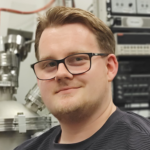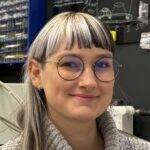
More very good news for our team! Piotr and Wiktoria have secured funding for their research projects under two programs supporting the development of young researchers!
Piotr received a grant within the PhDBoost program, addressed to doctoral students of the Poznan University of Technology Doctoral School and aimed at supporting research related to doctoral dissertations as well as fostering research independence. The program provides funding for research materials, scientific services, conference participation, and other activities, while also preparing participants to apply for external research grants.
Piotr’s project, entitled Raman and SERS Spectroscopy Response Studies in the Two-Dimensional Material PtSe₂ in the Context of Physical Unclonable Functions, focuses on investigating the optical response of the two-dimensional material PtSe₂ in the context of so-called Physical Unclonable Functions (PUFs). The project will analyze both Raman spectroscopy and its surface-enhanced version (SERS), including measurements performed after modifying the material with gold nanoparticles. A key aspect of the research will be mapping the optical signal and correlating it with the local surface structure. The goal is to evaluate whether such an optical response may exhibit the uniqueness and stability required for hardware security applications. The project represents fundamental research and will contribute to a deeper understanding of the optical properties of two-dimensional materials.
Meanwhile, Wiktoria obtained funding in the DS-MK “Młoda Kadra” competition (funds for the development of young researchers) at the Faculty of Materials Engineering and Technical Physics PUT. This program supports independent research projects conducted by young scientists and prepares them to apply for national and international research grants.
Her project, entitled Ab Initio Modeling of Structural Defects in G/SiC Heterostructures in the Context of Neutron Radiation Effects, focuses on analyzing the impact of neutron radiation on graphene/silicon carbide (G/SiC) heterostructures, considered as components of magnetic field sensors designed to operate in future fusion reactors. Rather than limiting the study to macroscopic observations, the project investigates what happens at the level of individual atoms. Advanced computational methods (DFT) will be used to better understand the mechanisms responsible for radiation resistance and to support the development of sensors capable of operating under extreme conditions.
Both programs constitute an important element of the support system for young researchers, enabling them to develop their own research concepts, build their scientific track record, and gain project management experience at an early stage of their careers.
Congratulations, and we wish them every success in the implementation of their projects!